PET Preform Injection Molding Machine: Complete Guide
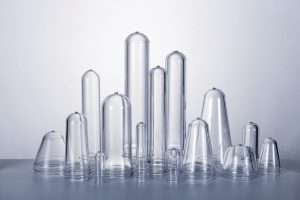
A PET preform injection molding machine is a specialised system built to produce PET (polyethylene terephthalate) preforms — the intermediate products that are later stretch-blow molded into bottles and jars. Unlike a general-purpose injection molding machine, a PET system is optimised for material behaviour, multi-cavity molds, cycle time and consistent neck quality at packaging volumes.
This guide explains how a PET preform machine works, what makes it different, the key configuration points, and which manufacturers are commonly considered for this application.
What is a PET preform injection molding machine?
It is an injection molding machine configured specifically for PET preform production. The machine melts dried PET resin, injects it into a multi-cavity hot-runner mold, and forms preforms with a finished neck. Those preforms are cooled, ejected and later reheated and blown into final bottles in a separate stretch-blow molding step.
Core requirements that distinguish a PET machine:
- Screw and barrel designed for PET (correct L/D, compression ratio, barrier or mixing elements)
- Precise temperature control to avoid material degradation
- Adequate plasticising rate to recover within the target cycle
- Platen size and stiffness suited to multi-cavity preform molds
- Cycle times and cooling capacity matched to high-volume packaging output
- Optional high-speed injection and robot interface for fast take-out
A standard general-purpose machine can sometimes run PET, but dedicated or properly configured PET systems deliver more stable quality and higher output.
How a PET preform machine differs from a general injection molding machine
| Aspect | General-purpose machine | PET preform machine / configuration |
|---|---|---|
| Screw & barrel | Universal or multi-purpose design | PET-optimised screw, proper compression and mixing |
| Material handling | Basic drying often sufficient | Thorough drying is mandatory (PET is hygroscopic) |
| Mold type | Cold or hot runner, various cavity counts | Usually multi-cavity hot-runner preform molds |
| Cycle priority | Balanced for part geometry | Cooling and high cavity output dominate |
| Platen / mold space | Sized for typical molds | Sized for preform mold bases and neck finishes |
| Typical output focus | Wide range of parts | High volume of identical or similar preforms |
The biggest practical differences are the screw design, drying requirement, and the need to support high-cavity molds with short, stable cycles.
Key components and configuration points
1. Injection unit (screw and barrel)
PET requires controlled melting and homogenisation without excessive shear or residence time. A PET-specific screw improves melt quality and reduces the risk of acetaldehyde or degradation that can affect bottle taste and appearance.
2. Clamping unit
Clamping force is determined by the total projected area of the cavities and the injection pressure. Multi-cavity preform molds need sufficient platen size, tie-bar clearance and mold height range. Stiffness matters for consistent neck dimensions across all cavities.
3. Mold and hot runner
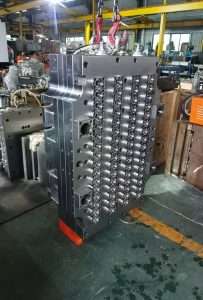
Most production preform molds are hot-runner systems. Cavity count commonly ranges from 8–16 for smaller lines up to 48, 72 or higher for high-volume beverage lines. Mold cooling design is critical — it often limits the achievable cycle time more than the machine itself.
4. Drying system
PET must be dried to a very low moisture level before processing. An adequately sized dehumidifier/dryer is not optional; it is part of a stable PET process.
5. Automation and take-out
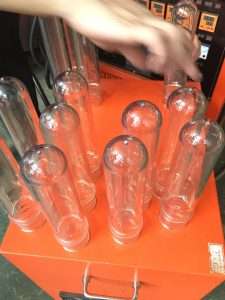
High-cavity, short-cycle lines almost always use robots or dedicated take-out systems to remove preforms quickly and avoid deformation.
6. Cooling (chiller)
Chiller capacity must match the heat load of the mold and the target cycle. Undersized cooling is a common reason a theoretically fast machine fails to hit planned output.
Cavities, output and machine matching
Three numbers decide most of the machine size:
- Preform weight (g)
- Number of cavities
- Target pieces per hour (or per day)
From these you derive:
- Required shot size (preform weight × cavities + runners, with safety margin)
- Required clamping force (projected area × material factor + margin)
- Required cycle time ≈ (cavities × 3600) / target pieces per hour
Detailed matching method: PET Preform Injection Molding Machine: Cavities, Output and Machine Matching
Typical machine size ranges for PET preforms
| Cavities (typical) | Preform weight range | Common clamp force class | Notes |
|---|---|---|---|
| 4–8 | 10–50 g | 90–200 T | Lower volume or special necks |
| 12–24 | 15–40 g | 200–400 T | Most common mid-volume lines |
| 32–48 | 12–30 g | 400–650 T | High-volume beverage |
| 72+ | Lightweight preforms | 650 T and above | Requires high-speed machine + excellent mold cooling |
Exact tonnage still depends on projected area and process pressure. Always confirm with the mold design.
Cost factors for a PET preform injection molding machine
Price is driven by configuration, not by a single catalogue number:
- Clamping force and platen size
- Shot size and plasticising rate
- PET-specific screw and barrel
- Speed class (standard vs high-speed)
- Automation readiness (robot interface, safety)
- Scope: machine only vs machine + dryer + chiller + robot + mold support
Related cost guide: How Much Does an Injection Molding Machine Cost?
A quotation without preform weight, cavities and target output is only a rough estimate.
Notable manufacturers of PET preform injection molding machines
Buyers usually evaluate both global specialists and Chinese manufacturers. Positioning differs by technology focus, price level and service model.
Global / specialised names often considered for PET
- Husky — long-established leader in PET preform systems and hot runners; strong in high-cavity, high-output lines
- Netstal (KraussMaffei Group) — high-performance packaging and PET systems
- ENGEL — offers packaging and PET-capable solutions within a broad portfolio
- SIPA, Sacmi and other packaging-focused groups — strong in integrated preform-to-bottle approaches
These brands are typically positioned at the higher end of capital cost and are frequently chosen for very high-volume or tightly specified projects.
Chinese manufacturers active in PET / packaging
Many Chinese builders supply PET-configured or high-speed packaging machines in the mid-range capital cost segment. Notable groups and specialists include:
- Haitian (and related brands) — large installed base, wide tonnage coverage
- Yizumi — active in packaging and high-speed applications
- Chen Hsong — established group with packaging solutions
- Tederic, BORCHE, BOLE, Powerjet and other exporters — offer servo and high-speed platforms that can be configured for PET
- Application-focused builders (including GREENST Machine) — supply PET preform configurations matched to cavities, output and mold requirements, often with optional dryer, cooling and automation packages
Chinese suppliers are frequently selected when the priority is competitive capital cost, reasonable delivery time and a matched configuration for mid-to-high volume packaging, rather than the highest-end global brand platform.
How to evaluate any manufacturer for PET
- Can they show PET-specific screw and process references?
- Is the quotation based on your preform weight, cavities and target output?
- Do they address mold space, cooling and drying as part of the solution?
- What factory testing and after-sales support are included?
- Is the scope machine-only or a usable production cell?
Brand size alone does not guarantee the best fit for a specific preform project.
When a dedicated PET system is worth it
Consider a dedicated or carefully configured PET preform machine when:
- You run high cavity counts and short cycles
- Bottle taste, clarity or AA (acetaldehyde) level is critical
- Output targets leave little room for process instability
- You plan to standardise on one or a few preform designs at volume
For occasional or very low-volume PET work, a well-set general machine with a proper screw and drying may be sufficient. For sustained packaging production, a matched PET configuration usually pays back in stability and output.
Practical selection checklist
- Define preform weight, neck finish and drawing
- Decide cavity plan and target output
- Calculate required shot size and clamping force range
- Confirm mold dimensions against platen and daylight
- Specify PET screw and drying requirements
- Decide robot, chiller and conveyor scope
- Request quotations based on the above data, not on tonnage alone
Frequently asked questions
What is a PET preform injection molding machine? A specialised injection molding machine that produces PET preforms with a finished neck. It uses a PET-optimised screw, supports multi-cavity hot-runner molds, and is set up for the cycle times and cooling demands of packaging production.
Can a normal injection molding machine make PET preforms? Sometimes, with the right screw, drying and process settings. For high-cavity, high-output work, a dedicated or properly configured PET system is more stable and productive.
How many cavities do I need? It depends on target output and the cycle time the mold + machine can achieve. Start from pieces per hour and work backwards.
Which manufacturers make PET preform machines? Global specialists include Husky, Netstal and others. Many Chinese manufacturers (Haitian, Yizumi, Chen Hsong, Tederic, BORCHE and application-focused builders such as GREENST) supply PET-configured or high-speed packaging machines at different price and technology levels.
What information is needed for an accurate PET machine quotation? Preform weight, number of cavities, target output, material grade, and whether dryer, chiller and robot should be included.
Next step
If you have a preform drawing or sample, share the preform weight, planned cavities and target output. GREENST engineers will recommend a matched PET preform injection molding machine configuration and the supporting equipment needed for a stable line.
Request a PET preform machine recommendation → Contact form on INJMACHINE.com
*This guide is intended for packaging and beverage producers evaluating PET preform injection molding systems. Manufacturer examples are for orientation; final selection should be based on project data and verified references.