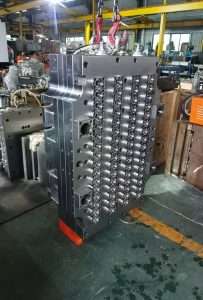
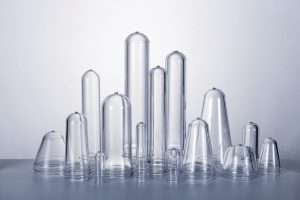
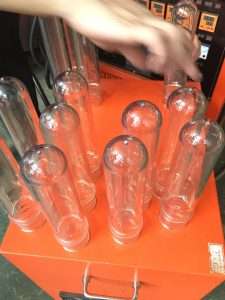
500ml D28mm 24cavities PET Preform Injection Molding Machine: Price, Output and 220T Selection Guide
For a 500 ml bottle project with a D28 neck finish, a 220T-class **PET preform injection molding machine** is a practical starting point for a 24-cavity mold when the confirmed preform weight is around 24 g. This guide explains how to select the machine, calculate output, estimate the project budget and match the PET preform mold with the dryer, chiller, robot and other auxiliary equipment.
It is written for beverage manufacturers, investors and production managers in Latin America, Africa, the Middle East, Southeast Asia and other growing packaging markets. The figures are preliminary engineering references. A firm recommendation requires the approved preform drawing or sample, verified weight, neck dimensions, target output, resin grade and installation conditions.
## Quick Answer: What Machine Is Suitable for a 500 ml D28 Preform?
A 218T or 220T PET preform injection molding machine may be suitable for a 24-cavity, approximately 24 g D28 preform. The reference IJT-SV220PET machine uses a 2,200 kN clamping-force class. Final suitability depends on total shot weight, mold dimensions, plasticizing capacity, injection performance and cooling time—not clamping force alone.
A preliminary preform-only project budget may fall between **USD 103,000 and 212,000** when it includes the injection machine, PET preform mold, dryer, loader, chiller, take-out system, installation and initial operating capital. This is a planning range rather than a quotation. Machine configuration, mold specification, destination, taxes and the scope of supply can change the final cost substantially.
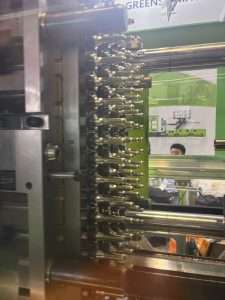 pet preform injection molding machine 64cavities
## Why the Preform Determines Bottle Quality
A PET preform is reheated and stretch-blow molded into the final 500 ml bottle. Preform weight, wall distribution, neck concentricity, gate quality and residual stress influence bottle clarity, top-load strength, impact resistance and material distribution after blowing.
A typical 500 ml D28 preform may weigh approximately 18–28 g. Still-water, carbonated-drink and lightweight bottle designs can require different weights and wall profiles. The 24 g example in this article is only a planning basis. The customer’s approved drawing must control the final calculation.
PET is hygroscopic. If the resin contains excessive moisture before melting, hydrolysis can reduce intrinsic viscosity (IV), weaken the preform and create haze, silver streaks or blowing instability. A properly sized dehumidifying dryer, stable dry-air dew point and correct residence time are essential parts of a PET bottle production line.
## 220T PET Preform Machine: The Main Selection Checks
Before selecting a **500ml D28 PET preform machine**, confirm the following:
1. Preform weight and total shot weight, including hot-runner material and a process margin.
2. Mold length, width, height and weight.
3. Tie-bar spacing and platen dimensions.
4. Injection pressure, injection speed and plasticizing rate for the selected PET resin.
5. Required cycle time and mold cooling performance.
6. Robot or dedicated take-out requirements.
7. Electrical power, cooling water, compressed air and installation space.
The reference IJT-SV220PET documentation records 530 × 530 mm tie-bar spacing, a 200–550 mm mold-height range and two injection-unit options. Its stated injection weights are based on polystyrene (PS), so they cannot be transferred directly to PET without density and process correction. The PET shot must be calculated from the actual drawing and machine data.
### Shot-size example
For a 24-cavity mold producing 24 g preforms:
text
Product shot = 24 cavities × 24 g = 576 g
Adding approximately 5–10% for the hot runner and process variation gives a preliminary total shot of about 605–634 g. A larger preform changes the result quickly: 28 g × 24 cavities equals 672 g before allowance, while 30 g × 24 cavities equals 720 g. In those cases, a larger injection unit or lower cavity count may be more appropriate.
## 16, 24 or 32 Cavities: Which PET Preform Mold Is Better?
Cavity number affects output, mold investment, machine size, cooling complexity and the cost of process interruptions.
| Cavity count | Typical machine class | Theoretical output at 18–20 s | Best suited for |
| ———— | ——————–: | —————————–: | ———————————– |
| 16 cavities | 160–180T | 2,880–3,200 preforms/hour | Lower volume or heavier preforms |
| 24 cavities | 200–220T | 4,320–4,800 preforms/hour | Most 500 ml D28 projects |
| 32 cavities | 250–280T | 5,760–6,400 preforms/hour | Higher-volume continuous production |
For many new beverage packaging projects, 24 cavities offer a useful balance between output, mold cost and process control. A 32-cavity PET preform mold can produce more parts but requires a larger machine, better cooling balance and a higher investment. Sixteen cavities may be suitable where demand is lower or the preform is heavier.
The mold should be designed around balanced filling, a stable D28 neck finish, efficient cooling and the required gate appearance. Open-gate hot runners are generally simpler and lower cost; valve-gate systems can provide better gate control and lower stringing at a higher mold price. The correct choice depends on the bottle specification and acceptance standard.
## PET Preform Production Capacity and Cycle Time
The basic formula is:
“`text
Hourly output = cavity number × 3,600 ÷ full cycle time in seconds
“`
For a 24-cavity mold, the planning outputs are:
| Full cycle | Theoretical output/hour | Theoretical output/24 hours | Practical planning output at 85–90% availability |
| ———: | ———————-: | ————————–: | ————————————————: |
| 18 s | 4,800 | 115,200 | 97,920–103,680 |
| 20 s | 4,320 | 103,680 | 88,128–93,312 |
| 22 s | 3,927 | 94,255 | 80,117–84,830 |
| 24 s | 3,600 | 86,400 | 73,440–77,760 |
These are preforms per day, not finished bottles. Actual output is reduced by start-up scrap, inspection, mold cleaning, resin changes, dryer alarms, maintenance and quality holds. Production planning and return-on-investment calculations should use practical availability rather than theoretical output.
The 18-second figure is a benchmark, not a guaranteed 24-cavity D28 cycle. Actual cycle time includes injection, holding, cooling, screw recovery, mold movement, take-out and safety interlocks. Cooling normally has the greatest influence. Independent neck, body and core cooling circuits, sufficient water flow and good thermal transfer can shorten the cycle while protecting dimensional stability.
## PET Preform Injection Molding Process
A stable PET preform manufacturing process normally includes:
1. **Drying:** Dehumidify bottle-grade PET to the resin supplier’s recommended moisture level, commonly below 50 ppm.
2. **Plasticizing:** Melt and homogenize the PET at controlled temperature and back pressure.
3. **Injection:** Fill the hot runner and cavities at a controlled speed and pressure.
4. **Packing and holding:** Compensate for shrinkage and form a dense, accurate neck finish.
5. **Cooling:** Solidify the preforms while the screw recovers for the next shot.
6. **Take-out:** Remove preforms with a robot or dedicated removal system without scratches or deformation.
7. **Inspection:** Check weight, gate quality, neck dimensions, clarity and visible defects.
A high-quality PET preform injection molding machine must work together with the mold and auxiliaries. Changing only injection pressure will not solve a drying, cooling or mold-balance problem.
## Recommended Auxiliary Equipment
A complete PET preform production line normally includes:
– Dehumidifying dryer and insulated hopper
– Hopper loader or closed conveying system
– Chiller and closed-loop mold-cooling system
– Mold temperature controller where required
– PET preform mold and hot-runner controller
– Take-out robot or dedicated removal system
– Conveyor and inspection table
– Air compressor and air treatment where pneumatic equipment requires it
– Water tank, pump and filtration system where site conditions require it
– Approved recycling or granulating equipment for controlled scrap handling
Dryer and chiller capacity should be calculated from PET kg/h throughput, residence time, ambient temperature, mold heat load and required water temperature. Oversizing by a reasonable engineering margin can improve stability, but unnecessary oversizing increases capital and energy cost.
A take-out robot is strongly recommended for 24-cavity and higher-output production. It helps keep cycle timing consistent and reduces neck deformation, scratches and manual handling. A conveyor can transfer preforms to inspection or packing, while a buffer allows the injection and downstream sections to operate with small differences in speed.
## Common PET Preform Defects
| Defect | Common cause | First checks |
| ———————— | ——————————————- | ————————————————- |
| Silver streaks or splay | Moisture or material degradation | Dryer performance, dew point and melt temperature |
| Haze or poor clarity | Moisture, contamination or overheating | Resin condition, cleaning and temperature profile |
| Neck dimension variation | Uneven cooling or unstable mold temperature | Neck cooling circuits and water flow |
| Weight variation | Unstable plasticizing or holding | Screw recovery, check valve and process control |
| Flash or short shot | Incorrect machine or mold settings | Clamp condition, injection pressure and venting |
| High gate vestige | Gate temperature or design issue | Hot-runner settings and gate specification |
Stable quality comes from the combination of dry resin, balanced mold filling, controlled cooling and repeatable machine settings.
## Preliminary PET Preform Mold and Project Cost
Budgeting must distinguish between a machine price and the cost of a complete production project. A preliminary planning structure may look like this:
| Cost block | Planning range (USD) | Main variables |
| ———————————————- | ——————-: | ————————————————— |
| 218T/220T PET injection machine | 35,000–65,000 | Injection unit, controller, options and destination |
| 24-cavity PET preform mold | 25,000–50,000 | Steel, hot runner, cooling and acceptance standard |
| Dryer, loader, chiller and temperature control | 15,000–30,000 | Throughput, redundancy and site conditions |
| Robot, conveyor and inspection | 3,000–12,000 | Automation level and layout |
| Freight, commissioning and spare parts | 10,000–25,000 | Country, port and site readiness |
| Initial PET resin and operating capital | 15,000–30,000 | Resin price, payment terms and inventory |
| **Preliminary preform-only total** | **103,000–212,000** | Excludes building, taxes and bottle blowing |
These figures are budgetary only. The final proposal should be based on the customer’s drawing, output target, country, utility conditions and agreed scope. If the project includes finished bottles, it also needs a stretch-blow molding machine, high-pressure compressor, air dryer, bottle mold, oven, filling and capping equipment, and packaging equipment.
## Installation, Commissioning and Local Support
A practical project schedule normally covers technical clarification, machine and mold production, pre-shipment testing, shipping, site preparation, installation, commissioning and operator training. The customer should prepare adequate floor strength, electrical power, cooling water, compressed air and material storage before delivery.
For buyers in Mexico, Guatemala, El Salvador, Honduras, Colombia, Peru, Kenya, Vietnam and other developing manufacturing markets, utility conditions and local technical support should be discussed at the quotation stage. The supplier should confirm spare parts, remote assistance, training scope, response arrangements and the documents required for customs and installation.
## Acceptance Checklist Before Ordering
Before approving a PET preform machine and mold, the buyer should request a written technical comparison rather than relying on the tonnage name alone. Confirm that the quotation identifies the exact machine model, screw diameter, theoretical injection capacity, tie-bar spacing, mold-height range, motor or servo system, controller, warranty and included accessories. The mold quotation should identify the cavity number, neck standard, hot-runner type, steel grades, cooling circuits, gate specification, expected mold life and spare-insert policy.
A useful factory acceptance test should include the customer’s approved preform drawing, agreed PET resin, measured cycle time, preform weight variation, neck dimensions, gate appearance and visual quality. If the supplier quotes a production rate, ask whether it is theoretical or demonstrated output and whether it includes take-out, inspection and normal stoppages. The same distinction should be used when comparing a PET preform machine price in China with offers from suppliers in Europe, Turkey or other manufacturing regions.
The complete project should also be reviewed from a layout and operating perspective. The injection cell needs safe access for mold changes, dryer loading, chiller maintenance and robot adjustment. The electrical panel, cooling-water loop, compressed-air system and resin storage should be accessible to trained operators. A lower purchase price can become expensive if the dryer is too small, the mold cooling is unstable, spare parts are unavailable or commissioning is excluded.
For a new factory, a phased investment may be practical: start with a 16- or 24-cavity preform line, validate the local bottle market and add a second mold, blow-molding machine or filling line when demand is confirmed. For an existing beverage producer, the better choice may be a higher-cavity PET preform mold with automated inspection and planned redundancy. The correct answer depends on product design, sales volume, working shifts and the customer’s expansion plan.
## Frequently Asked Questions
### Can a 220T machine produce 500 ml D28 PET preforms?
It may be suitable when the verified preform weight, total shot, mold dimensions and cycle are within the machine’s working range. Confirmation requires the preform drawing and formal machine data.
### How many preforms does a 24-cavity mold produce per cycle?
One complete cycle produces 24 preforms. At an 18-second cycle, the theoretical output is 4,800 preforms per hour before downtime and quality losses.
### Is an 18-second PET preform cycle guaranteed?
No. It is a planning benchmark. The actual cycle must be proven with the selected mold, PET resin, preform weight and quality requirements.
### What information is needed for a quotation?
Send the preform drawing or sample, weight, D28 neck dimensions, desired cavity number, daily or hourly target, resin grade, existing mold data, project country, electrical supply and planned start-up date.
### Can the machine process different preform weights?
It can run different molds within its shot, mold-size and plasticizing limits. Each new preform requires process validation. A heavier preform may require a larger injection unit or fewer cavities.
### Is rPET possible?
Many PET preform systems can process a controlled percentage of suitable rPET. The resin must be properly dried and its IV, filtration and final bottle-performance requirements must be evaluated before production.
## Request a Matched PET Preform Solution
INJMACHINE.com, the official international platform of GREENST MACHINE, supplies matched solutions for PET preforms and bottle packaging. Our scope can include the **PET preform injection molding machine**, 24-cavity or other preform molds, dryer, loader, chiller, robot, conveyor and technical support.
Explore our [PET machine range] [PET packaging applications]and [turnkey project solutions]To request a technical proposal, use our [contact page] and provide your preform drawing or sample, target output and installation country.
Our engineering team will verify whether a 218T/220T-class machine is appropriate or recommend a different cavity count, injection unit or complete PET bottle production line.