D28 PET Preform Injection Molding Machine: 29 g, 48-Cavity and 330PET Project Guide
Quick answer
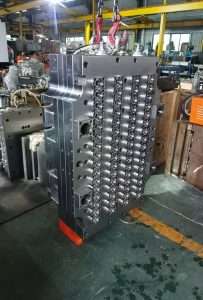
For the project configuration described in this article, the preliminary production cell consists of a **330PET PET preform injection molding machine**, a **48-cavity D28 preform mold**, and an **SLH-800L/500 three-in-one system for drying, dehumidifying and conveying PET resin**. The customer-supplied preform weight is 29 g.
The net product mass per cycle is:
48 cavities x 29 g = 1,392 g of PET preforms per cycle
This 1,392 g figure is the product mass. It is the starting point for the injection-unit check, not a complete machine approval by itself. The engineering team must convert the approved product mass into PET melt volume using the density basis in the technical file, confirm the selected screw cushion and shot-utilization basis, and verify plasticizing and recovery time against the target cycle.
The hot-runner manifold contains melt during production, but its full internal volume is not simply added to the product weight as if the same runner material were consumed in every normal cycle. Hot-runner volume is reviewed for start-up material, purge, residence time, thermal balance, pressure loss and process control. This distinction is important when selecting a PET preform machine shot capacity.
The final selection should be released after reviewing the approved D28 neck and preform drawing, mold dimensions, hot-runner design, PET grade, target cycle, utilities and mold-trial results. The 330PET machine and SLH-800L/500 system are the project direction supplied for this article; their exact formal specifications remain to be confirmed from the current technical files.
Project configuration at a glance
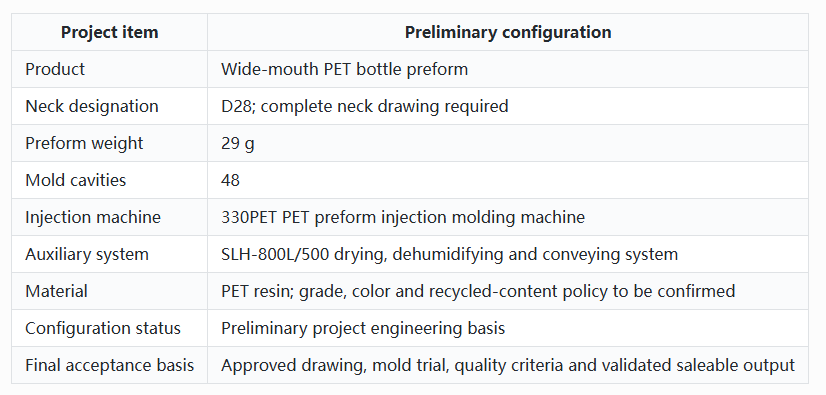
The project name “330PET” refers to the PET preform configuration built around the IJT-SV330 platform. The formal file `IJT-SV330PET.docx` identifies the table model as IJT-SV330 and confirms 3,300 kN clamp force. The current technical revision and the final injection-unit option must still be stated on the quotation; the numeral alone is not enough to approve a PET preform project.
Formal IJT-SV330PET technical reference
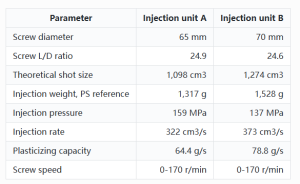
The following values are transcribed from `IJT-SV330PET.docx`. The injection weights are theoretical PS reference values in the source file. They are not a direct PET shot guarantee and must be converted and checked against the approved 29 g preform, PET melt-density basis, cushion and shot-utilization requirement.
| Parameter | Injection unit A | Injection unit B |
The common clamp and machine fields are:
| Parameter | Formal reference |
|—|—:|
| Clamp tonnage | 3,300 kN |
| Toggle stroke | 660 mm |
| Space between tie bars | 685 x 685 mm |
| Mold-height range | 270-670 mm |
| Ejector stroke | 170 mm |
| Ejector tonnage | 90 kN |
| Ejector quantity | 13 pcs |
| Pump motor power | 34 kW |
| Heater power | 31.05 kW |
| Machine dimensions | 7.2 x 1.76 x 2.4 m |
| Machine weight | 13.5 t |
| Oil tank capacity | 850 L |
For this 48-cavity project, the formal A/B injection-unit options create two different engineering paths. Unit B has the larger theoretical volume, higher listed injection rate and higher listed plasticizing capacity, while unit A lists higher injection pressure. The correct choice depends on the approved preform flow length, gate design, PET grade, target cycle and validated pressure and recovery requirements. This article does not select A or B without the mold trial and current technical review.
Why the 29 g preform and 48 cavities determine the machine choice
A PET preform injection molding machine is selected from the complete process window, not from bottle volume or clamping tonnage alone. The 29 g unit weight determines the mass of each preform. The 48-cavity layout multiplies that mass and creates a simultaneous requirement for injection balance, plasticizing capacity, cooling, take-out and inspection.
The first calculation is direct:
Product shot = cavity count x preform weight
Product shot = 48 x 29 g = 1,392 g
The next step is to convert mass into the injection volume required by the approved PET grade and processing condition. The supplier should show the basis used for density, because a machine catalogue may state a theoretical shot weight using PS while the project uses PET. Those two values should not be compared without a clear conversion basis.
PET shot-volume and utilization check
The engineering calculation should be documented as:
Product melt volume = product mass / PET melt density
Required metering volume = product melt volume / selected shot-utilization ratio
The utilization ratio is a project engineering decision. It must leave room for a stable screw cushion, process variation and the validated molding window. It should not be invented as a universal percentage for every PET machine. The quotation should state whether its shot value is reported as theoretical PS weight, PET-equivalent mass, screw metering volume or another basis.
The hot-runner system must be reviewed at the same time, but not by adding its entire internal volume to every normal-cycle product weight. The mold maker and machine supplier should confirm how the hot-runner design affects filling pressure, pressure loss, start-up purge, residence time and thermal control. Any cold-runner material, gate waste or process discard must be described separately if it exists in the selected mold design.
Plasticizing and screw-recovery check
The machine must plasticize enough PET for the next shot within the available cycle window. The technical review should compare screw-recovery time with cooling, mold opening, take-out and mold-closing time. If screw recovery is longer than the available window, the nominal clamp platform may still be unsuitable for the planned output.
The review should record:
– net product shot at the approved 29 g weight;
– PET density and the melt-volume basis;
– selected screw diameter and PET screw/barrel configuration;
– metering volume, cushion and shot-utilization basis;
– injection speed and pressure for the preform geometry;
– plasticizing rate and screw-recovery time;
– mold dimensions, mold height, tie-bar spacing and platen clearance;
– electrical, cooling-water and compressed-air requirements.
These checks prevent a common purchasing mistake: selecting a machine that can close the mold but cannot plasticize and inject the required PET shot within the agreed cycle.
What D28 means, and what it does not mean
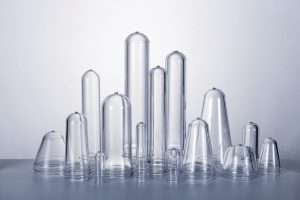
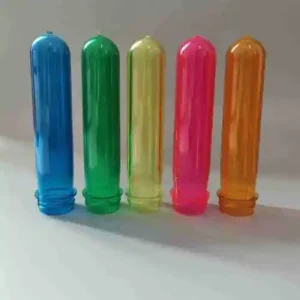
D28 is used here as the customer’s neck-finish designation. It is not a complete preform specification. Before the 48-cavity PET preform mold is manufactured, the customer and mold engineer should confirm:
1. thread profile and cap compatibility;
2. support-ring diameter and axial position;
3. inner diameter and sealing surface;
4. neck height and transition radius;
5. gate type and acceptable gate vestige;
6. preform body length, base geometry and wall-thickness distribution;
7. dimensional tolerances after injection and after stretch-blow molding.
Two preforms can use a D28 designation while differing in body length, mass, thread profile and stretch-blow behavior. The approved drawing remains the controlling document. The 29 g value is a project input, not a universal D28 standard.
The phrase “wide-mouth PET preform” should also be tied to the customer’s final bottle application. It may refer to a particular opening, cap system or product design. It should not be used to infer a bottle volume, food-contact approval or blow-molding performance without project evidence.
Why the 330PET direction requires technical confirmation
The supplied project basis identifies a 330PET PET preform injection molding machine as the preliminary direction. The formal IJT-SV330PET file provides the two injection-unit options shown above. The engineering review should confirm that the selected option meets all of the following requirements together:
– clamp force for the projected mold area and process pressure;
– platen size, tie-bar spacing and mold-height range;
– PET-specific injection volume and shot capacity;
– required screw cushion and shot-utilization basis;
– injection speed for balanced filling across 48 cavities;
– plasticizing rate for approximately 1.4 kg of product per cycle;
– screw recovery before the next cycle;
– stable barrel and mold temperature control for the approved PET grade;
– electrical, cooling-water and compressed-air requirements at the factory.
The 685 x 685 mm tie-bar spacing and 270-670 mm mold-height range in the formal IJT-SV330 reference should be checked against the 48-cavity mold drawing. The formal 1,098 cm3 and 1,274 cm3 shot-size values are machine reference fields; they should not be treated as a final PET capacity until the supplier documents the PET conversion, cushion and utilization basis.
The 330PET machine should be quoted as part of a production cell. The mold, SLH material-preparation system, cooling circuit, take-out system and inspection method must be checked against the same target. With 48 cavities, one filling imbalance, blocked cooling circuit or material-quality problem can affect a large number of preforms in every cycle.
SLH-800L/500 three-in-one PET material-preparation system
The proposed auxiliary equipment is an **SLH-800L/500 three-in-one combination of drying, dehumidifying and conveying**. This equipment is important because PET resin must be prepared and protected from moisture before it reaches the injection unit. A closed conveying path can also reduce exposure to ambient moisture and contamination between the dryer and machine hopper.
The 2022 SMANL catalogue identifies `SLH-800L/500` as an 800 L model with a 500 m3/h dry-air blower. It also lists the following catalogue values. Because the catalogue states that specifications may change without notice, the current supplier revision should be checked before a purchase order is released.
| SLH-800L/500 parameter | Catalogue reference |
| Capacity | 800 L |
| Dry blower air volume | 500 m3/h |
| Power of heater | 18 kW |
| Power of dry blower | 5.5 kW |
| Power of regenerating blower | 0.75 kW |
| Power of air pump | 2.2 kW |
| Power of regenerating heater | 4 kW |
| Pipe diameter | 51 mm |
| External dimensions L x W x H | 1,750 x 1,900 x 1,900 mm |
These values describe the catalogue model and do not by themselves prove a PET kg/h output, achieved dew point or suitability for every resin grade. The final quotation should confirm the applicable PET material throughput, operating conditions, dew-point measurement and utility requirements for this 48-cavity cell.
Drying function
The drying section conditions PET resin before plasticizing. The technical review should confirm the drying temperature range, residence-time basis, hopper insulation, regeneration method, filters, alarms and material-contact construction. Capacity should be matched to actual resin consumption from the 48-cavity cell, with the supplier’s stated operating conditions and margin.
Dehumidifying function
The dehumidifying section supports stable moisture control. The quotation should identify the expected dew-point performance, how dew point is measured, regeneration control, start-up procedure and the operator checks required after a shutdown or material change. The catalogue confirms the system concept and model row, but the achieved dew point remains a current project verification item.
Conveying function
The conveying section transfers dried PET to the injection machine. The layout should confirm conveying distance, pipe diameter, receiver volume, filters, material-return routing, cleaning access and protection against contamination. If the customer uses color dosing or an approved recycled-PET blend, the material-handling design should be reviewed separately.
The catalogue’s 500 m3/h dry-air value and 800 L capacity are useful for the initial equipment schedule. The SLH-800L/500 system must still be sized against validated PET consumption and the customer’s operating conditions, not merely the clamp label of the 330PET machine. An undersized or poorly integrated system can leave the machine mechanically capable of the shot while preventing stable continuous production.
Cycle time and output logic
Theoretical output is calculated from cavities and full cycle time:
Theoretical pieces per hour = 48 x 3,600 / full cycle time in seconds
The project brief does not include a validated cycle, so the following are planning scenarios only:
| Assumed full cycle | Theoretical pieces/hour | Product mass/hour at 29 g |
| 18 seconds | 9,600 | 278.4 kg/h |
| 20 seconds | 8,640 | 250.6 kg/h |
| 22 seconds | 7,855 | 227.8 kg/h |
These figures are mathematical scenarios, not a GREENST or INJMACHINE performance guarantee. Full cycle includes injection, holding, cooling, screw recovery, mold opening and closing, take-out and transfer delay. Saleable output must also account for start-up pieces, rejects, cleaning, maintenance and equipment availability.
For investment planning, separate three numbers:
1. Theoretical output: cavities multiplied by cycles per hour.
2. Validated production output: output recorded during a trial using the approved mold, PET grade and quality limits.
3. Saleable output: validated output after rejects, start-up, cleaning, maintenance and planned availability.
Only saleable output should be used for a commercial capacity or payback model. A trial report should record cycle time, preform weight, cavity-to-cavity variation, neck dimensions, gate quality, appearance and rejection rate.
Mold design priorities for a 48-cavity PET preform mold
A high-cavity PET preform mold must balance filling, cooling and maintenance. The technical review should cover:
– balanced hot-runner and gate layout for all 48 cavities;
– neck-ring and thread dimensions from the approved D28 drawing;
– 29 g preform tolerance and cavity-to-cavity consistency;
– gate design and acceptable gate-vestige height;
– independent cooling circuits for neck, core and body regions;
– mold steel, heat treatment, polishing and corrosion resistance;
– cavity numbering and inspection records;
– spare cavities, cores, neck rings and hot-runner components;
– safe installation envelope on the 330PET machine;
– take-out interface and preform orientation.
The mold acceptance plan should define measurements for preform weight, neck diameter, thread profile, overall length, support-ring position, visual appearance, haze, black specks, gate quality and deformation after cooling. Downstream stretch-blow validation remains the final application test.
Cooling, take-out and inspection
The cooling package must be matched to mold heat load and the target cycle. Depending on site conditions, the complete cell may include a chiller, circulating pump, tank, filtration and flow monitoring. The final specification should state supply and return temperatures, flow rate, pressure, water quality and ambient design conditions.
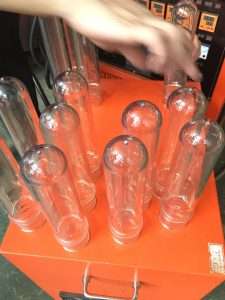
Take-out automation must support the 48-cavity layout and the preform neck. Incorrect handling can scratch or deform fresh preforms. The quotation should define start-up-part handling, rejected-part separation, mold-cleaning access and transfer to inspection or packing. If manual handling is selected, the customer should confirm the labor and quality-control method.
Inspection should be tied to the approved drawing. Typical checks may include preform weight, neck dimensions, length, support-ring position, gate vestige, haze, black specks, color and deformation. Exact tolerances must come from the customer’s product and bottle-performance specification.
Complete INJMACHINE project scope
INJMACHINE.com is the international platform for GREENST MACHINE’s injection molding equipment and complete plastic injection project capability. For this project, the scope can be structured as follows:
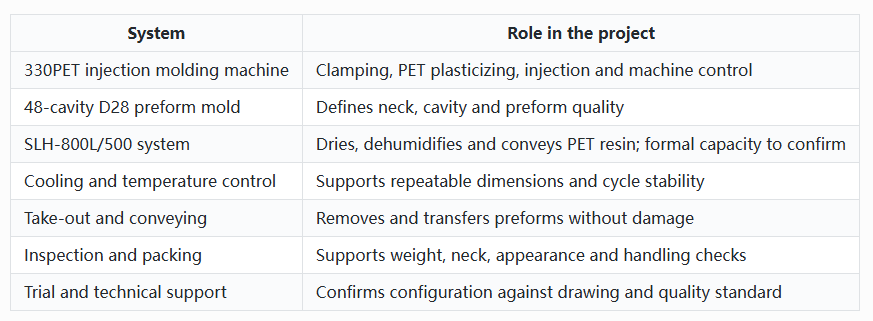
The INJMACHINE PET machine category can serve as the product entry point. Related model pages and parameters should be checked against the latest approved technical file before publication or quotation. The website should show the relationship between machine, mold, material preparation, cooling, automation and production support rather than presenting the 330PET label as a complete specification.
Buyer checklist for a comparable quotation
Ask each supplier to show the same technical fields:
– exact 330PET model and injection-unit configuration;
– shot basis and units, including whether the number is PS, PET-equivalent or metering volume;
– PET density assumption and selected shot-utilization basis;
– recommended cushion and screw-recovery time;
– injection speed, pressure and plasticizing rate;
– mold dimensions, tie-bar spacing and mold-height range;
– 48-cavity mold hot-runner and cooling scope;
– SLH-800L/500 throughput, dew point, hopper volume and utilities;
– cooling heat-load basis and water requirements;
– take-out method, inspection and packing boundary;
– trial protocol, included spare parts, installation and acceptance criteria.
A quotation that lists only “330T” and a machine price is not technically comparable with a complete PET production-cell proposal.
Information required before final quotation
The current project brief and the two supplied technical sources support a substantially documented preliminary configuration. Final engineering approval still requires:
– approved D28 neck and complete preform drawing;
– confirmation of the wide-mouth application and final bottle use;
– PET grade, color and recycled-content policy;
– accepted 29 g tolerance band;
– mold dimensions, mold height, hot-runner design and cooling layout;
– target full cycle and saleable output;
– factory power, cooling-water, water-quality and compressed-air data;
– site layout and conveying distance;
– automation and packing requirements;
– destination country, installation boundary and spare-parts scope;
– current revision confirmation for the IJT-SV330PET injection-unit data;
– current revision confirmation for the SLH-800L/500 catalogue values;
– written acceptance criteria for the mold and production trial.
Frequently asked questions
What machine is suitable for a 29 g D28 PET preform with 48 cavities?
The project direction is a 330PET PET preform injection molding machine based on the IJT-SV330 platform. The formal file lists 65 mm and 70 mm screw options, 1,098 cm3 and 1,274 cm3 theoretical shot sizes, and 3,300 kN clamp force. Final suitability depends on the selected injection unit, PET-specific shot volume, screw cushion, shot-utilization basis, mold dimensions, PET grade, target cycle and trial results.
How much PET is in one shot?
The net product mass is 1,392 g per cycle: 48 cavities multiplied by 29 g. Machine selection should convert this mass into PET injection volume and include the agreed cushion and operating margin. The full hot-runner volume should not be added as material consumed in every normal cycle; it is reviewed for start-up, residence time, thermal balance, pressure loss and process control.
What does SLH-800L/500 do?
It is the proposed three-in-one system for drying, dehumidifying and conveying PET resin. The 2022 SMANL catalogue lists 800 L capacity, 500 m3/h dry-air volume, 18 kW heater power, 5.5 kW dry-blower power, 0.75 kW regenerating-blower power, 2.2 kW air-pump power, 4 kW regenerating-heater power, 51 mm pipe diameter and 1,750 x 1,900 x 1,900 mm dimensions. The current revision and project-specific PET throughput must be confirmed before ordering.
Is 9,600 pieces per hour guaranteed?
No. It is the theoretical result of 48 cavities at an assumed 18-second cycle. Validated saleable output requires a trial with the actual mold, PET grade, 29 g preform and agreed quality criteria.
Is D28 enough information to design the mold?
No. The complete drawing must define thread, support ring, sealing surface, inner diameter, body geometry, gate, tolerances and downstream stretch-blow requirements.
Can INJMACHINE supply the machine and auxiliary equipment together?
INJMACHINE.com can coordinate the injection machine, PET preform mold, resin drying and conveying, cooling, take-out and production support as a complete project scope. The quotation should state which items are included, optional or customer-supplied.
Conclusion
The preliminary configuration for this wide-mouth D28 PET preform project is a **29 g preform**, **48-cavity mold**, **330PET injection molding machine**, and **SLH-800L/500 drying, dehumidifying and conveying system**. The net product requirement is 1,392 g per cycle. Machine approval depends on PET-specific injection volume, screw cushion, shot utilization, plasticizing capacity, mold geometry, process window and factory utilities.
A product-first review gives the buyer a more reliable path than selecting equipment by clamp tonnage alone. Send the approved preform drawing, mold data and target output to [INJMACHINE.com](https://injmachine.com/) for a formal review of the machine, mold, material-preparation system, cooling and take-out package. The engineering team can then confirm the exact 330PET configuration and the technical capacity of the SLH-800L/500 system before quotation.