Quick Answer
Customer Usage & Equipment Selection Guide: A 5-gallon (18.9L) PET water bottle line normally combines PET resin drying, thick-wall preform injection molding, post-cooling, reheating and stretch-blow molding. The correct machine and mold depend on preform weight, neck finish, cavity number, cycle time and target output.
Use the figures in this guide for preliminary planning only. Final specifications should be confirmed by sample testing and the selected machine and mold configuration.
This practical guide is designed for factory owners, production managers and equipment buyers planning to manufacture 5-gallon (18.9L) PET water bottles.
It explains the complete two-stage production process, including PET preforms, injection molding machines, auxiliary equipment, robots, conveyors, blow molds and stretch-blow molding machines. For a broader overview, read our PET preform injection molding machine guide.
Actual specifications should be confirmed according to the bottle design, preform weight, required output, factory conditions and selected mold.
1. Production Process Overview
The standard two-stage production process includes:
- PET resin drying and dehumidification
- Injection molding of thick-wall PET preforms
- Robot take-out and post-cooling
- Conveying and temporary buffering
- Preform reheating and stretch-blow molding
- Bottle cooling, inspection and packaging
The actual production capacity depends on the number of preform cavities, injection cycle time, blow molding capacity, operating hours and equipment availability.
Typical daily output ranges
| Production scale | Typical daily output | Typical configuration |
|---|---|---|
| Entry level | 2,000–5,000 bottles/day | 2–4 preform cavities + 1 blow molding machine |
| Medium scale | 5,000–10,000 bottles/day | 4–8 preform cavities + 1 or 2 blow molding machines |
| High capacity | 10,000–20,000+ bottles/day | Higher-cavity or multiple injection and blow molding machines |
These figures are preliminary planning ranges. Final output must be calculated from the actual preform weight, cycle time, cavity number and production schedule.
2. PET Preform Specifications
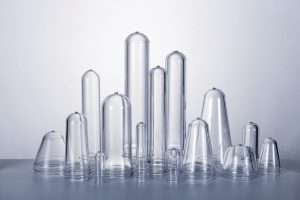
5-gallon bottles may use different preform designs depending on whether they are returnable water bottles or lightweight single-use bottles.
| Item | Returnable 5-Gallon Bottle | Lightweight / Single-Use Bottle |
|---|---|---|
| Typical preform weight | 650–800 g | 350–450 g |
| Typical wall thickness | Approximately 8–10 mm | Approximately 5–7 mm |
| Neck finish | Standard 5-gallon neck, approximately 55 mm | According to bottle design |
| Material | Food-grade PET | Food-grade PET |
| Recommended IV value | Approximately 0.76–0.80 or according to application | According to application |
The actual preform weight and wall thickness depend on the bottle structure, neck design, material grade, mold design and required mechanical strength.
Key preform quality requirements
- Uniform wall thickness
- Stable preform weight
- Good concentricity
- No bubbles, black spots or visible contamination
- Low residual stress
- Proper moisture control
- Good transparency and mechanical strength
3. Injection Molding Machine Selection
The injection machine should be selected according to the total preform weight, mold cavity number, cycle time and required production output. For a smaller bottle reference, see our 500ml D28 PET preform machine selection guide.
The following table provides a preliminary reference based on preforms weighing approximately 700–750 g.
| Configuration | Approx. cycle time | Theoretical output | Suitable application |
|---|---|---|---|
| 2 cavities | 100–120 s | 60–72 preforms/hour | Small start-up projects |
| 4 cavities | 100–120 s | 120–144 preforms/hour | Small and medium production |
| 8 cavities | 90–120 s | 240–320 preforms/hour | Higher production requirements |
| Dual 2+2 cavities | According to mold design | Approximately 120–144 total preforms/hour | Higher productivity within limited floor space |
| Dual 4+4 cavities | According to mold design | Approximately 240–320 total preforms/hour | Large-scale production |
Output calculation example
For a four-cavity mold with a 120-second cycle:
3,600 ÷ 120 × 4 = 120 preforms/hour
For an eight-cavity mold with a 90-second cycle:
3,600 ÷ 90 × 8 = 320 preforms/hour
Actual output may be lower because of mold adjustment, material loading, quality inspection, maintenance and planned downtime.
Important machine selection parameters
The required shot capacity should be calculated as:
Total preform weight + runner weight + suitable safety margin
For example, a four-cavity mold producing 750 g preforms requires approximately:
750 g × 4 = 3,000 g of preform material per cycle
The final machine selection must also consider:
- Required clamping force
- Mold dimensions and mold weight
- Mold opening stroke
- Maximum daylight
- Ejector stroke
- Injection pressure and speed
- Servo energy-saving system
- Robot communication interface
- Post-cooling requirements
- Factory power supply and installation conditions
Dual-mold or multi-mold systems can improve productivity, but the required machine configuration must be verified by the mold supplier and injection molding machine manufacturer.
4. Essential Auxiliary Equipment
A complete PET preform production line normally includes the PET preform machine series and the following auxiliary equipment:
- Dehumidifying dryer
- PET hopper loader
- Color dosing or masterbatch dosing unit
- Mold temperature controller
- High-capacity industrial chiller
- Air compressor and air receiver
- Cooling water tank and piping
- Robot take-out system
- Preform post-cooling device
- Conveyor and buffer system
- Granulator for approved in-line recycling applications
PET is highly sensitive to moisture. Proper drying is required to reduce hydrolysis, brittleness, haze and quality instability.
A commonly used reference is:
- PET moisture before processing: generally below 50 ppm, according to the resin supplier’s recommendation
- Dryer and chiller capacity: normally selected with an engineering margin of approximately 20–30%
The final capacity should be calculated according to resin consumption, ambient temperature, water temperature, cycle time and local operating conditions.
5. Robot and Conveyor System
For thick-wall 5-gallon preforms, a robot take-out and post-cooling system is strongly recommended.
It can help to:
- Remove preforms safely from the mold
- Reduce deformation during early cooling
- Improve preform straightness
- Shorten the time that the preform remains inside the mold
- Improve production stability
- Reduce manual handling
The robot should be matched with the machine, mold layout and preform weight.
A conveyor and buffer system can provide smooth transfer between the injection and blowing sections. It should preferably include:
- Scratch-resistant contact surfaces
- Stable preform spacing
- Buffer capacity for temporary production differences
- Visual inspection access
- Defect removal or rejection function
- Easy cleaning and maintenance
6. Blow Mold and Blow Molding Machine
Blow mold
A single-cavity blow mold is commonly used for 5-gallon bottles, especially for small and medium production projects. Multi-cavity solutions may be considered for higher output requirements.
Important blow mold design points include:
- Efficient base cooling
- Uniform bottle wall thickness
- Proper venting
- Accurate neck and handle positioning
- Easy demolding
- Suitable mold material and surface treatment
- Compatibility with the selected blow molding machine
Blow molding machine capacity
| Machine type | Typical output | Suitable application |
|---|---|---|
| Semi-automatic, 1 cavity | Approximately 60–120 BPH | Small and medium production |
| Optimized semi-automatic | Approximately 90–120 BPH | Projects requiring stable output |
| Fully automatic / servo | Up to approximately 200 BPH | Higher production and reduced labor |
BPH means bottles per hour. Actual capacity depends on preform heating time, bottle design, cooling time, operator efficiency and machine configuration.
The heating system should use multi-zone infrared heating. It must provide sufficient heat penetration for thick-wall preforms while protecting the neck area from deformation.
7. Practical Customer Checklist
Planning stage
Before selecting equipment, confirm:
- Returnable or single-use bottle design
- Preform weight
- Bottle dimensions and total weight
- Target daily or monthly production
- Number of bottle designs
- Existing factory or new investment project
- Available installation space
- Electrical power supply
- Compressed air availability
- Cooling water conditions
- Machine-only or complete turnkey line requirement
Equipment selection and acceptance
Before placing an order, request:
- Confirmed machine specification
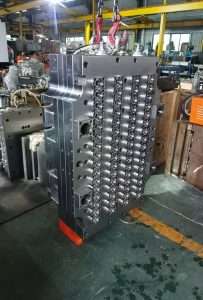
- Mold cavity layout
- Calculated cycle time
- Expected hourly and daily output
- Energy consumption data
- Compressed air consumption
- Cooling water requirements
- Trial production video
- Preform weight consistency data
- Bottle wall thickness distribution
- Sample bottle drop-test results
- Installation and training plan
It is preferable to work with a supplier that has experience with thick-wall PET preforms, post-cooling systems and complete injection-to-blowing production lines.
Daily operation
Operators should check:
- Dryer dew point and PET moisture
- Material drying temperature and time
- Cooling water temperature and flow
- Mold temperature
- Air pressure
- Preform weight
- Machine alarms and oil temperature
- Heating lamp condition
- Bottle appearance and wall thickness
Heating lamps should be cleaned according to the operating environment. Product weight, dimensions, appearance and drop-test performance should be sampled regularly according to the factory’s quality-control procedure.
8. Common Problems and Possible Solutions
| Problem | Possible causes | Recommended direction |
|---|---|---|
| Long injection cycle | Insufficient cooling or inefficient cooling channels | Improve mold cooling and post-cooling |
| Preform bending | Early removal, uneven cooling or poor handling | Adjust take-out timing and cooling conditions |
| Uneven bottle wall thickness | Incorrect heating profile or stretching parameters | Adjust heating zones, stretch timing and air pressure |
| Hazy preform | Insufficient drying or excessive moisture | Check dryer performance and material moisture |
| Short shot | Insufficient injection capacity, pressure or material temperature | Review shot size, injection settings and mold filling |
| Bottle deformation | Inadequate cooling or unstable blow molding conditions | Optimize cooling, mold temperature and blowing parameters |
The correct solution should be confirmed through sample testing and process analysis rather than changing only one machine parameter.
9. How to Match the Complete Production Line
A complete turnkey production solution should be matched in the following order:
Bottle design → Preform design → Preform mold → Injection machine → Auxiliary equipment → Post-cooling → Blow mold → Blow molding machine → Inspection and packaging
For example, a project targeting 5,000 bottles per day may require a different configuration from a project targeting 15,000 bottles per day, even when both projects use the same 18.9L bottle format.
The final recommendation should be based on:
- Bottle and preform drawings
- Preform weight
- Required output
- Number of cavities
- Factory power and air supply
- Available floor space
- Investment budget
- Labor availability
- Future expansion plans
10. Next Steps
This guide provides a practical reference for planning a 5-gallon PET water bottle production line. The final configuration should be confirmed after reviewing the actual product and factory conditions.
INJMACHINE can help prepare:
- Capacity calculations based on your target output
- Comparison of 2-, 4- and 8-cavity preform solutions
- Injection machine and mold recommendations
- Complete auxiliary equipment lists
- Blow mold and blow molding machine matching
- Estimated power and compressed-air requirements
- A complete turnkey production-line proposal
To prepare a suitable recommendation, please send us:
- Bottle photo, drawing or sample
- Required bottle weight and application
- Expected daily or monthly output
- Returnable or single-use bottle requirement
- Installation country and available power supply
- Preferred investment range
After receiving this information, our engineering team can recommend a suitable machine, mold and complete production configuration.